

The American sycamore, belonging to the genus Platanus, is one of the most massive and long-lived deciduous trees in the Northern Hemisphere. Depending on the geographic region and the specific species, this tree is also popularly known as river cottonwood or London plane.
This giant is characterized by rapid growth and a monumental structure, serving as a key component in the natural engineering of riparian ecosystems (riverbanks) and a fundamental element in modern urban planning thanks to its extensive shade coverage.
In this technical article, the morphological characteristics, taxonomic history, and maintenance requirements of the sycamore are analyzed, providing a comprehensive guide for its correct identification and management.

Taxonomic Identification and Related Species
The classification of the sycamore has been the subject of extensive study in recent decades. Although Platanus occidentalis is the most widespread species in North America (from Canada to Texas), there are geographically significant variants of great scientific importance.
An important milestone in botany occurred in the year 2003, when researchers Nixon and Poole formally described Platanus rzedowskii. This species, which primarily inhabits mountain areas and riverbanks in northeastern Mexico, was identified as a distinct entity after demonstrating that it possesses a unique genetic mosaic that differentiates it from the common sycamore.
Bark Morphology: The Exfoliating Trait
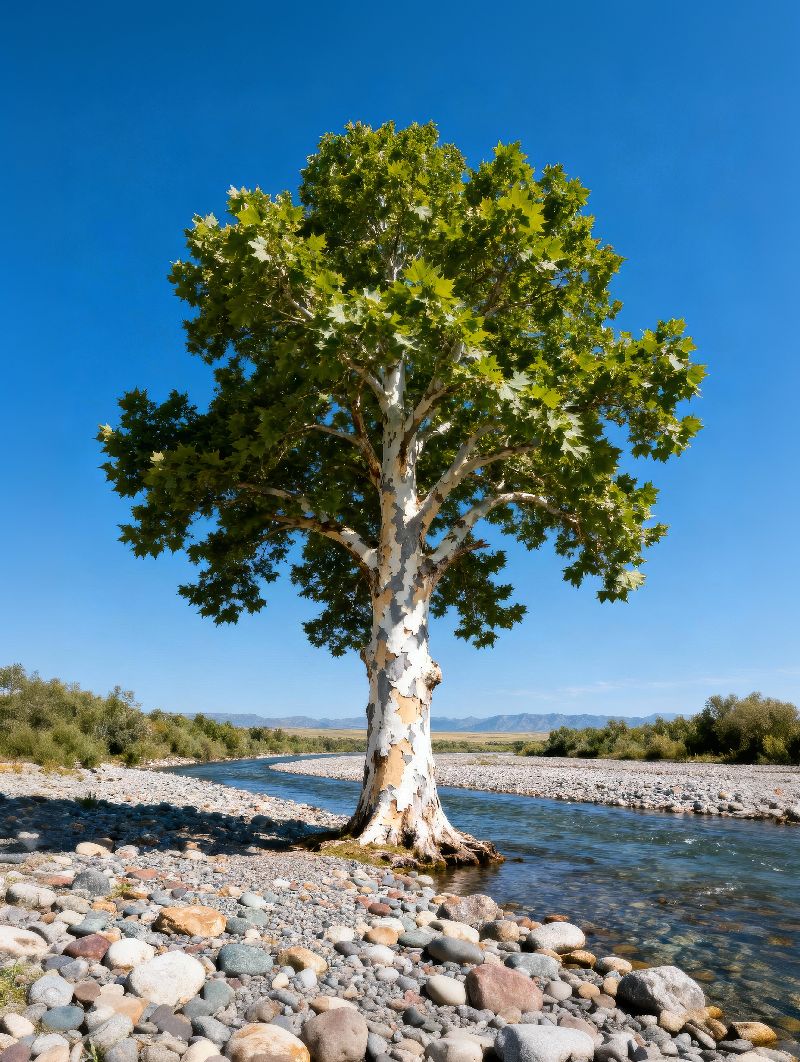
The most distinctive visual feature of the genus Platanus is its bark. Unlike most trees, the outer bark of the sycamore is rigid and lacks the elasticity needed to accommodate the rapid growth of the trunk.
As a result, the outer layer cracks and peels off in large plates or sheets, a process known as exfoliation. This phenomenon reveals inner layers of light colors ranging from chalky white and cream to greenish or grayish tones, creating a mosaic or “camouflage” pattern that is vital to the health of the trunk, allowing it to naturally shed epiphytes and parasites.

Habitat and Geographic Distribution
The American sycamore is a facultative wetland species, which means that although it can adapt to urban soils, its optimal habitat is near permanent or seasonal bodies of water.
Distribution in North America
Its range of distribution is wide:
- American sycamore (Platanus occidentalis): It predominates in the central and eastern United States and southern Canada, adapting to temperate climates and deep alluvial soils.
- Platanus rzedowskii (Rzedowski’s Sycamore): An endemic species primarily found in the canyons and riverbeds of the Sierra Madre Oriental in Mexico, demonstrating remarkable resistance to extreme temperature fluctuations.
Regardless of the species, these trees prefer soils with a neutral to slightly acidic pH and a high moisture retention capacity, factors that are crucial for reaching their maximum biological development potential.
Anatomy of the Sycamore: Distinctive Characteristics
The genus Platanus exhibits a unique morphology that has evolved to optimize its survival in riparian environments. Each of its parts features specific traits that allow for unmistakable identification, even for non-expert observers.
The Trunk: A Mosaic of Peeling Bark
The trunk of the American sycamore is perhaps its most peculiar and striking feature. Unlike other large trees, its bark is not elastic.
- Exfoliation Process: As the trunk diameter increases, the outer bark, rigid and brittle, peels off in large irregular plates.
- Coloration: This shedding reveals internal layers of a smooth texture and strongly contrasting colors: from bright whites and creams in the upper parts to grays and olive greens in the middle areas.
- Base of the Trunk: In very old specimens, the base of the trunk can develop a thicker, darker, and deeply furrowed bark that no longer sheds, providing additional protection against mechanical impacts.

Leaves: Palmate and Functional Design
The leaves of the cottonwood or sycamore are notably large, reaching between 4 and 10 inches wide. Their design is a key element of their physiology:
- Shape: They are simple, alternate, and palmately lobed leaves, with 3 to 5 pointed lobes. Their appearance resembles that of a maple leaf, but with a generally larger arrangement and size.
- Color and Texture: The upper side (adaxial) is a deep green, while the underside is a paler green. Unlike Populus alba, it does not have the silvery white hairs, although young leaves may show slight pubescence that disappears as they mature.
- Petiole: A very peculiar technical characteristic is the base of the petiole (the leaf stem), which is hollow and completely wraps the bud for the following year, protecting it until the leaf falls in autumn.

The Fruit: Pendulous Spheres
The fruit of the sycamore is easily recognizable by its perfect spherical shape, which has earned it common names related to “balls” or “buttons” in various cultures.
- Structure: It is a dense globular head, composed of hundreds of small individual seeds (achenes) surrounded by fine, stiff hairs.
- Arrangement: The fruits hang from long, slender peduncles, generally solitary in the American sycamore (Platanus occidentalis) or in pairs in other varieties.
- Maturation: They remain on the tree throughout much of the winter, acquiring a dark brown tone until they disintegrate to release the seeds to the wind or water.

The Root System: Strength and Stabilization
Given its large size, the sycamore requires exceptional anchorage. Its roots are vigorous, extensive, and possess a highly developed hydrotropic ability (water-seeking). This system not only supports the massive weight of the tree but also acts as a biological containment network, being essential to prevent erosion of the alluvial soils where the tree prefers to establish itself.
Environmental Benefits and Ecosystem Services
The American sycamore is not just an ornamental element; it is a high-performance green infrastructure. Due to its biomass and longevity, it provides environmental services that few trees can match.
Climate Change Mitigation and Air Quality
As a fast-growing species, the cottonwood has an exceptionally high carbon sequestration rate.
- CO2 Capture: A single mature specimen can absorb tons of carbon dioxide throughout its life, storing it in its dense wood.
- Particle Filtration: Its large palmate leaves act like magnets for dust and suspended particles (PM10), improving air quality in industrial and urban areas.
Thermal Regulation and Erosion Control
The shade of a sycamore can reduce soil temperature by up to 10°C. Additionally, its role in hydrology is vital:
- Flood Control: Its roots increase soil porosity, allowing better infiltration of rainwater into the aquifers.
- Bank Stabilization: It is the “engineer” of rivers; its intertwined roots prevent strong currents from eroding the banks, protecting both the ecosystem and adjacent properties.
Sycamore Cultivation and Care Guide
For those considering integrating a sycamore or cottonwood into their landscape projects, it is essential to understand its technical requirements to ensure healthy development and avoid conflicts with infrastructure.
Light and Soil Requirements
It is a heliophilic species, which means it requires full sun exposure. In shaded conditions, the tree tends to etiolate (grow weakly stretched) and becomes susceptible to fungal diseases. It prefers deep soils, rich in organic matter and with a constant moisture retention capacity, although it tolerates clay soils if there is good drainage.
Space Management and Planting
Due to its vigorous root system and massive canopy, the following recommendations should be followed:
- Distance from Structures: It is recommended to plant at a minimum distance of 8 to 10 meters from foundations, drainage pipes, and sidewalks.
- Critical Watering: During the first three years after planting, watering should be deep and frequent, mimicking the moisture of its natural riparian habitat.
Common Pests and Diseases
Despite its robustness, the genus Platanus can be affected by:
- Sycamore Anthracnose: A fungus that affects young leaves and shoots during wet springs. Although it is aesthetically damaging, it rarely kills a healthy tree.
- Lace Bug (Corythucha ciliata): An insect that feeds on the sap on the underside of leaves, causing premature yellowing in summer.
Conclusion: The Value of the Sycamore in Global Ecology
The American sycamore (including species such as Platanus occidentalis and the recently classified Platanus rzedowskii) represents the strength and resilience of nature. Its ability to transform arid landscapes into refreshing oases makes it an indispensable ally in the face of global warming.
Valuing the cottonwood is to understand the deep connection between water, soil, and atmosphere. Whether on the bank of a wild river or in the heart of a metropolis, these giants with white bark will continue to be guardians of our biodiversity, as long as we respect their space and ensure their conservation for future generations.


